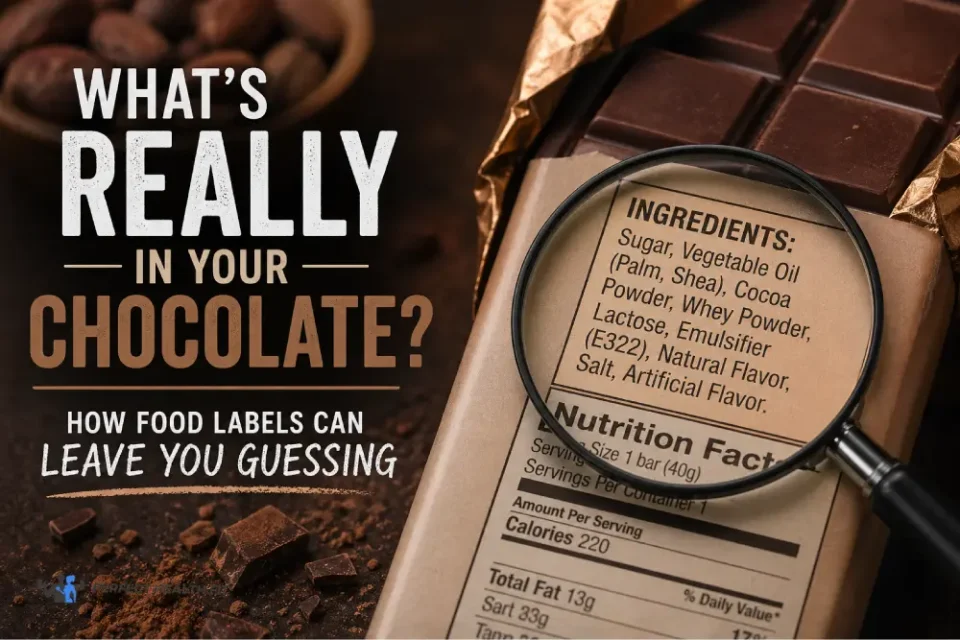
When consumers across the country started noticing that a beloved candy tasted waxier, less chocolatey, and somehow off, it sparked a surprisingly important conversation, not just about one brand, but about how food labels actually work and what they’re really telling you.
According to Companies Behaving Badly, the controversy centered on whether well-known chocolate products had been quietly reformulated, and whether consumers even had a reliable way to know if they had been.
Here’s what the situation reveals about food labeling, and why it matters for your health and your family’s diet.
Table of Contents
What Does “Milk Chocolate” Actually Mean?
Most people assume the words on a candy wrapper describe the product inside. In a regulatory sense, that’s partially true, but only up to a point.
Under U.S. Food and Drug Administration (FDA) standards, a product can only be labeled “milk chocolate” if it meets minimum thresholds for chocolate liquor, milk solids, and milk fat. Those minimums exist to protect consumers from misleading labels.
What those standards don’t guarantee is that the product will taste the same year after year. Manufacturers can legally adjust ingredient sourcing, alter fat ratios within acceptable limits, or change processing methods, and as long as the formulation still meets the FDA’s minimums, the label stays the same.
That’s a gap worth understanding as a health-conscious consumer.
“Chocolate” vs. “Chocolate Candy”: A Label Distinction That Matters
One of the more surprising elements of this conversation is how much a single word on a label can change what’s actually in the product.
If a product says “milk chocolate,” it must meet FDA compositional standards. But if it says “chocolate candy,” those same rules don’t apply. That wording choice gives manufacturers significantly more flexibility in what they can include or exclude.
The same logic applies to “white chocolate” versus “white creme.” White chocolate must meet cocoa butter requirements under federal rules. White creme has no equivalent standard.
None of this is illegal. But it does mean that similar-sounding product names can describe very different things, and that consumers don’t always have an easy way to spot the difference at the checkout line.
Why Do Formulations Change?
Food companies reformulate products more often than most people realize, and they’re rarely required to announce it. Common reasons include:
- Rising ingredient costs (cocoa prices, in particular, have been volatile in recent years)
- Supply chain disruptions
- Shifts in sourcing relationships
- Pressure to protect profit margins
If the ingredient list still technically meets regulatory requirements, no label change is required, even if the taste or texture shifts noticeably. This is true across the food industry, not just in chocolate.
What Should Consumers Take Away From This?
This isn’t a story about any one company doing something illegal. It’s a story about the limits of food labeling as a consumer protection tool.
Labels are designed to confirm regulatory compliance. They’re not designed to promise that nothing has changed behind the scenes, or that the product you buy today is identical to the one you bought five years ago.
For health-conscious consumers, that means a few practical takeaways:
Read ingredient lists, not just the product name. The name on the front of the packaging is a marketing description. The ingredient list is the more reliable source of information about what’s actually inside.
Understand that “less” can still be legal. A product meeting the minimum threshold for “milk chocolate” may contain far less cocoa than another product wearing the same label.
Pay attention to label language shifts. If a product you’ve bought for years suddenly says “chocolate candy” or “creme” instead of “chocolate,” that’s a meaningful change, even if the packaging looks identical.
Trust your senses. If something tastes different, it may be because something changed. Consumer feedback has repeatedly prompted companies to revisit formulations.
The Bigger Picture
Food labeling in the United States is built around regulatory floors, not consumer experience. Companies that operate at or near those minimums are fully compliant, and fully within their rights.
But compliance and transparency aren’t the same thing. When consumers notice changes they weren’t informed about, the result is a loss of trust that no label can repair.
Being an informed consumer means understanding not just what the label says, but what it’s not required to tell you. That knowledge is one of the simplest tools you have for making better choices for yourself and your family.